Positive ovulation test: what it really means
A positive ovulation test shows that an increase in the hormone LH has occurred. Ovulation usually happens within one to two days afterwards, but the test predicts it rather than confirms it has happened. In most cases, a positive result means you are in the most fertile part of your cycle.
 Linda Alexandersson2 September 20268 min read

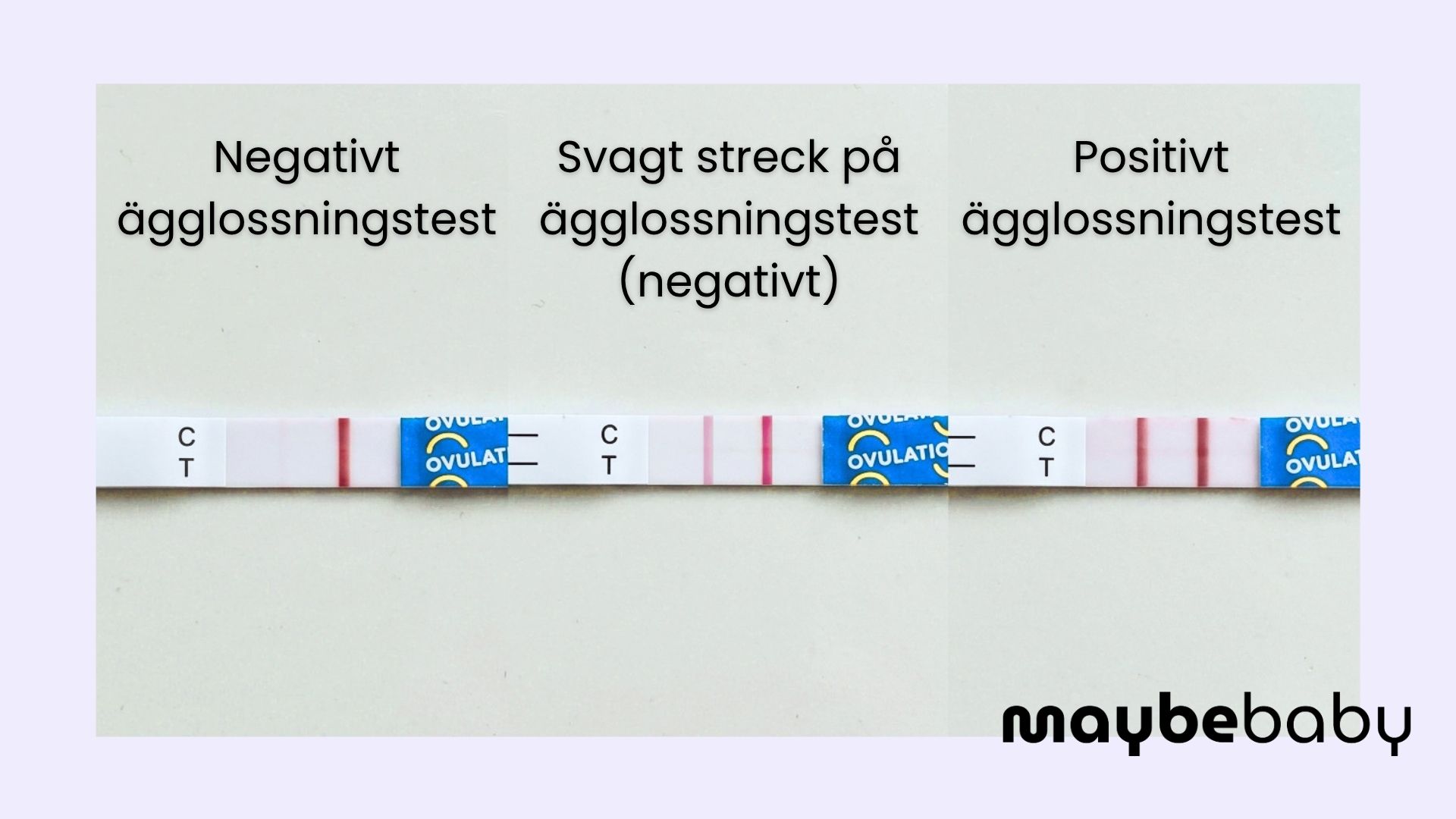
On a strip-format ovulation test, the test is positive when the test line is as dark as or darker than the control line. A lighter line counts as negative, even if it is clearly visible. This differs from a pregnancy test, where any visible line counts.
What an ovulation test can show
To find the right days, an ovulation test is the most practical tool available. It is simple, affordable, and you do it at home.
An ovulation test measures LH in urine and compares the level against a fixed threshold. It does not show how high your LH is, only whether it is above or below the threshold. Where the threshold sits also differs between manufacturers. Threshold values range from 20 to 50 mIU/ml, and there is no established threshold that is considered best [1].
This means a positive result is not the same as ovulation being certain to occur. How often the test is actually followed by ovulation has been studied.
In a study where ovulation was verified by ultrasound, a first positive test was followed by ovulation within 24 hours in roughly half to six out of ten cases. A negative test was considerably more reliable in the same study [1]. The participants had relatively regular cycles, and the figures apply to that study's tests and thresholds, not to all tests on the market.
The test is therefore better at showing when ovulation is probably not close than at confirming it will actually happen.
What an ovulation test cannot show
An ovulation test only looks at LH, the hormone that usually rises just before ovulation. It can help you find your most fertile days, but it does not say much about why your cycle looks the way it does or what conditions you have for ovulation and fertility overall.
Several other hormones play a role. FSH helps control the development of the follicles where eggs mature. Prolactin can, if too high, disrupt or inhibit ovulation [2]. Thyroid hormones affect the menstrual cycle and can, when imbalanced, contribute to irregular or absent ovulation [3]. And AMH provides information about egg reserve, something LH cannot say anything about [4].
An ovulation test therefore gives a snapshot of LH in this particular cycle. Looking at more hormones can provide a broader picture of what is happening behind the ovulation itself and which factors may influence it.
What do different ovulation test results mean?
Most people get a clear pattern: negative results, one positive, then negative again. But not always, and most deviations are harmless.
Ovulation test positive for several days
Usually completely normal. LH can remain at an elevated level for a couple of days before the egg is released, and the peak is more of a wave than a spike [1]. It is the first positive result that counts. Positive results over many days, cycle after cycle, may have other explanations. More on that further down.
Faint line on ovulation test
A faint line means negative. The test line should be as dark as or darker than the control line. Usually it simply means LH is at a low, normal level, which it almost always is. Digital tests work differently and interpret the result for you. Follow the instructions for your own test.
Positive in the morning, negative in the evening
LH is released in pulses, not evenly throughout the day [5], so the level can vary between two tests on the same day. A negative result after a positive one does not necessarily mean the first was wrong.
Negative ovulation test on ovulation day
A short surge can pass between two tests if you test once a day [1]. It is therefore possible to ovulate without any test showing positive. The tests work best as guidance, not as a definitive answer.
When a positive test does not mean ovulation
A positive test shows that LH has risen. It does not guarantee the egg will be released. There are three common explanations.
The surge does not lead to ovulation. LH can pass the test's threshold without the egg being released. The reasons vary and may involve an anovulatory cycle, how the follicle has developed, or other hormonal factors. A urine test cannot distinguish between them. LH can also rise on more than one occasion during the same cycle, which can produce two separate positive results.
The follicle does not rupture. The hormones look like a normal ovulation, but the follicle does not rupture and the egg is never released. The condition is called LUF, luteinised unruptured follicle. What makes it difficult to detect is that everything else appears normal. How common it is varies considerably between different studies and groups [6].
The baseline LH level is elevated. In PMOS, polyendocrine metabolic ovarian syndrome [7], LH is often higher throughout the cycle, and the ratio between LH and FSH can be shifted [8]. If the baseline level is close to the test's threshold, the result can be positive for much of the cycle without any real surge having occurred.
This is the explanation behind what is sometimes called a false positive ovulation test. The test does exactly what it is supposed to: it reports an LH level. It is therefore possible to have an elevated LH level, and thus a positive result, without ovulation occurring.
The reverse also applies. An absent temperature rise, a period that arrives early, or a pregnancy that is delayed do not necessarily mean ovulation did not happen. These are indirect signs, and they can have other explanations.
What a fertility test can show
An ovulation test helps you with one thing: timing. That is often exactly what you need. But if something else is affecting your cycle, it will not show up on a test strip, no matter how carefully you test.
A fertility test measures several hormones at once and shows the levels rather than comparing them against a threshold.
Your egg reserve. Whether you have more or fewer eggs remaining than other women your age. Your AMH level gives a picture of your egg reserve and fertility [4].
Early signals. Whether your levels show something worth discussing further with a doctor.
PMOS screening. Screening of hormones linked to PMOS and other common hormonal imbalances [8].
Menopause. Your AMH levels can give an indication of whether you will enter menopause earlier or later than average [4].
Thyroid. How your thyroid is doing. The thyroid can affect mood, skin, weight, energy, and ovulation [3].
An ovulation test is a good tool for finding the right days. But it is built to answer a single question, and it says nothing about the hormone levels behind it.
Curious about your own fertility?
Our quiz takes two minutes and gives you a free personalised report about your cycle and fertility.
Take the quizFrequently asked questions
How long after a positive ovulation test does ovulation happen?
Usually within 24 to 48 hours. The chance of conceiving is highest during that window.
How long are you fertile after a positive ovulation test?
The day of the positive test and the day after are the most fertile, since ovulation usually occurs within that day.
How long are you fertile during a cycle?
The fertile window is usually counted as six days: the five days before ovulation and ovulation day itself. Sperm can survive several days in the body, while the egg can be fertilised for a much shorter time.
Can you get pregnant after ovulation?
The chance drops quickly. The fertile window ends on ovulation day, since the egg can only be fertilised for about one day.
How long does the egg live after ovulation?
About one day. The reason the fertile window is still six days long is because sperm can survive in the body for several days and be ready when the egg is released.
Can you have a positive ovulation test but not ovulate?
Yes. A positive test shows an LH surge, not that the egg has been released.
How long does the LH surge last?
The surge varies between people and between cycles. The LH peak is more of a wave than a spike, and levels can remain elevated for some time after ovulation.
Can you get pregnant despite a negative ovulation test?
Yes. The test can miss the surge, especially when testing once per day.
Why is there no ovulation despite a positive ovulation test?
It could be an interrupted surge, a follicle that does not rupture, or an elevated baseline LH level.
References
- Leiva, R., Bouchard, T., Abdullah, S., & Ecochard, R. (2017). Urinary luteinizing hormone tests: Which concentration threshold best predicts ovulation? Frontiers in Public Health, 5, 320.
- Sonigo, C., Bouilly, J., Carré, N., et al. (2012). Hyperprolactinemia-induced ovarian acyclicity is reversed by kisspeptin administration. Journal of Clinical Investigation, 122(10), 3791-3795.
- Krassas, G. E. (2000). Thyroid disease and female reproduction. Fertility and Sterility, 74(6), 1063-1070.
- Jamil, Z., Fatima, S. S., Ahmed, K., & Malik, R. (2016). Anti-Mullerian hormone: Above and beyond conventional ovarian reserve markers. Disease Markers, 2016, 5246217.
- Reed, B. G., & Carr, B. R. (2018). The normal menstrual cycle and the control of ovulation. In Endotext. MDText.com.
- Killick, S., & Elstein, M. (1987). Pharmacologic production of luteinized unruptured follicles by prostaglandin synthetase inhibitors. Fertility and Sterility, 47(5), 773-777.
- 1177 Vårdguiden. (n.d.). Polycystiskt ovarialsyndrom, PCOS/PMOS.
- Coyle, C., & Campbell, R. E. (2019). Pathological pulses in PCOS. Molecular and Cellular Endocrinology, 498, 110561.
The information in this article is not medical advice. Always consult a doctor for a personal assessment.
Keep reading

PMOS
What is PMOS (formerly PCOS), and how do you know if you have it?
PMOS, formerly known as PCOS, is a common hormonal and metabolic syndrome. It can affect periods and ovulation, hair growth, fertility and metabolic health, and the symptoms can look different from woman to woman.
10 min readRead article

Contraception
Can you take Maybe Baby's fertility test if you use contraception?
Yes, you can take our tests even if you use hormonal contraception, such as the pill, hormonal IUD, implant, vaginal ring, patch, injection or mini pill. Here we go through how the different methods affect your hormones, what answers you get if you test while using them, and when it is best to test.
9 min readRead article

Guide
LH, the hormone behind ovulation
What LH does in your cycle and why it is the hormone ovulation tests measure.
Read the guide
Want to know more about your hormones?
Maybe Baby's fertility test measures 12 markers from home: ovulation, thyroid, energy, and egg reserve.
Order fertility test